Sunday, 22 December 2013

What Is Love

What Is Love Poem Definition

Source(google.com.pk)
W.S. Merwin is a major American writer whose poetry, translations, and prose have won praise since W.H. Auden awarded his first book, A Mask for Janus (1952), the Yale Younger Poets Prize. Though that first book reflected the formalism of the period, Merwin eventually became known for an impersonal, open style that eschewed punctuation. Writing in the Guardian, Jay Parini described Merwin’s mature style as “his own kind of free verse, [where] he layered image upon bright image, allowing the lines to hang in space, largely without punctuation, without rhymes . . . with a kind of graceful urgency.” Although Merwin’s writing has undergone stylistic changes through the course of his career, a recurring theme is man’s separation from nature. The poet sees the consequences of that alienation as disastrous, both for the human race and for the rest of the world. Merwin, who is a practicing Buddhist as  well as a proponent of deep ecology, has lived since the late 1970s on an old pineapple plantation in Hawaii which he has painstakingly restored to its original rainforest state.

Merwin was born in New York City in 1927 and raised in New Jersey and Scranton, Pennsylvania, the son of a Presbyterian minister. Of his development as a writer, Merwin once said, “I started writing hymns for my father almost as soon as I could write at all, illustrating them . . . But the first real writers that held me were not poets: Conrad first, and then Tolstoy, and it was not until I had received a scholarship and gone away to the university that I began to read poetry steadily and try incessantly, and with abiding desperation, to write it.”  Merwin attended Princeton University and studied with R.P. Blackmur and John Berryman. After graduating in 1948, he continued as a post-graduate student of Romance languages and eventually traveled through much of Europe, translating poetry and working as a tutor, including for the son of poet Robert Graves. Merwin’s early collections—especially A Mask for Janus—reflect the influence of Graves and the medieval poetry Merwin was translating at the time.

Indeed, the poetic forms of many eras and societies are the foundation for a great deal of Merwin’s poetry. His first books contain many pieces inspired by classical models. According to Vernon Young in the American Poetry Review, the poems are traceable to “Biblical tales, Classical myth, love songs from the Age of Chivalry, Renaissance retellings; they comprise carols, roundels, odes, ballads, sestinas, and they contrive golden equivalents of emblematic models: the masque, the Zodiac, the Dance of Death.” In 1956, Merwin was offered a fellowship from the Poets’ Theater in Cambridge, Massachusetts and returned to the U.S. His books from this period, Green with Beasts (1956) and The Drunk in the Furnace (1960), show the beginning of a shift in style and tone as Merwin began to experiment with irregular forms. The Drunk in the Furnace, which was written during Merwin’s tenure in Boston when he was meeting poets like Robert Lowell, particularly shows his new engagement with American themes. His obsession with the meaning of America and its values can make Merwin sometimes seem like the great nineteenth-century poet Walt Whitman, L. Edwin Folsom noted in Shenandoah. “His poetry . . . often implicitly and sometimes explicitly responds to Whitman; his twentieth-century sparsity and soberness—his doubts about the value of America—answer, temper, Whitman’s nineteenth-century expansiveness and exuberance—his enthusiasm over the American creation.”

Merwin’s next books are his most critically acclaimed and continue to be influential volumes. The Lice (1967), though often read as a response to the Vietnam War, condemns modern man in apocalyptic and visionary terms. “These are poems not written to an agenda but that create an agenda,” wrote poet and critic Reginald Shepherd, “preserving and recreating the world in passionate words. Merwin has always been concerned with the relationship between morality and aesthetics, weighing both terms equally. His poems speak back to the fallen world not as tracts but as artistic events.” The Lice remains one of Merwin’s best-known volumes of poetry. His next book, The Carrier of Ladders (1970) won the Pulitzer Prize for poetry in 1971. He famously donated the prize money to the draft resistance movement, writing an essay for the New York Review of Books that outlined his objections to the Vietnam War. His article spiked the ire of W.H. Auden, who wrote a response arguing that the award was apolitical. The Carrier of Ladders shows Merwin continuing to engage with American themes and nature, and includes a long sequence on American westward expansion. That same year, Merwin published The Miner’s Pale Children: A Book of Prose. Reviewing both volumes for the New York Times, Helen Vendler noted that “these books invoke by their subtitles the false distinction between prose and poetry: the real distinction is between prose and verse, since both are books of poems, with distinct resemblances and a few differences.”

Merwin moved to Hawaii to study Zen Buddhism in 1976. He eventually settled in Maui and began to restore the forest surrounding his former plantation. Both the rigor of practicing Buddhism and the tropical landscape have greatly influenced Merwin’s later style. His next books increasingly show his preoccupation with the natural world. The Compass Flower (1977), Opening the Hand (1983), and The Rain in the Trees (1988) “are concerned not only with what to renounce in the metropolis but also what to preserve in the country,” noted Ed Hirsch in the New York Times. Many of the poems in the last volume “immerse themselves in nature with a fresh sense of numinousness,” said Hirsch, while also mourning the loss of that nature to human greed and destruction. Merwin has continued to produce striking poems using nature as a backdrop. The Vixen (1996), for instance, is an exploration of the rural forest in southwestern France that Merwin called home for many years. New Yorker critic J. D.  McClatchy remarked that “the book is suffused with details of country life—solitary walks and garden work, woodsmoke, birdsong, lightfall.” But Merwin’s later poetry doesn’t merely describe the natural world; it also records and condemns the destruction of nature, from the felling of sacred forests to the extinction of whole species. Migration: New and Selected Poems (2005) exposes Merwin’s evolution as a stylist over half a century but also shows, as Ben Lerner noted in his review of the volume for Jacket, that “Merwin . . . is an unwaveringly political poet . . .  [he] not only tracks the literal impoverishment of our planet, but he makes it symbolize the impoverishment of our culture’s capacity for symbolization.” Migration was awarded the National Book Award for poetry.

Some literary critics have identified Merwin with the group known as the oracular poets, but Merwin himself once commented: “I have not evolved an abstract aesthetic theory and am not aware of belonging to any particular group of writers.” Reviewing Migration for the New York Times, Dan Chiasson described Merwin poems as “secular prophecy grounded on perceptual fineness.” But while Merwin’s work from the 1960s and early ‘70s perhaps best embody this mode, Chiasson believed that “its signature open form has been preserved whatever the occasion. What began as stylistic necessity has become a mannerism.” Merwin has continued to win high praise for his poetry, however, including the 2009 Pulitzer Prize for his collection The Shadow of Sirius (2008). The book’s three sections deal with childhood and memory, death and wisdom, and are some of the most autobiographical of his career. The Pulitzer Prize committee cited the book for its “luminous, often-tender poems that focus on the profound power of memory.”

In addition to writing poetry, prose and drama, Merwin is an accomplished and prolific translator of poetry. His translation of Dante’s Purgatorio (2000) and the Middle English epic Sir Gawain and the Green Knight (2004) both won high praise for their graceful, accessible verse. Merwin has also translated poets as diverse as Osip Mandelstam and Pablo Neruda. His many honors include, the Bollingen Prize, two Pulitzer Prizes, the Aiken Taylor Award for Modern American Poetry a Ford Foundation grant, the Ruth Lilly Poetry Prize, the PEN Translation Prize, the Shelley Memorial Award, the Wallace Stevens Award, and a Lila Wallace-Reader’s Digest Writers’ Award. He has also been awarded fellowships from The Academy of American Poets, the Guggenheim Foundation, the National Endowment for the Arts, and the Rockefeller Foundation. Merwin is a former Chancellor of The Academy of American Poets and has served as Special Consultant in Poetry to the Library of Congress in 1999-2000 and as Poet Laureate in 2010-2011.

Merwin was once asked what social role a poet plays—if any—in America. He commented: “I think there’s a kind of desperate hope built into poetry now that one really wants, hopelessly, to save the world. One is trying to say everything that can be said for the things that one loves while there’s still time. I think that’s a social role, don’t you? ... We keep expressing our anger and our love, and we hope, hopelessly perhaps, that it will have some effect. But I certainly have moved beyond the despair, or the searing, dumb vision that I felt after writing The Lice; one can’t live only in despair and anger without eventually destroying the thing one is angry in defense of. The world is still here, and there are aspects of human life that are not purely destructive, and there is a need to pay attention to the things around us while they are still around us. And you know, in a way, if you don’t pay that attention, the anger is just bitterness.”

What Is Love Poem 

What Is Love Poem 

What Is Love Poem 
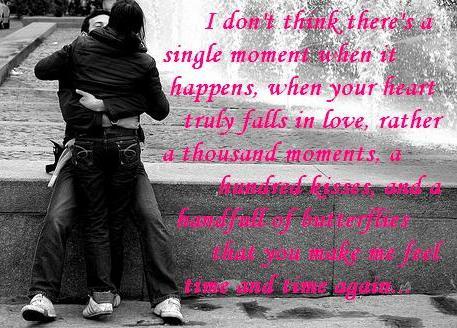
What Is Love Poem 

What Is Love Poem 

What Is Love Poem 

What Is Love Poem 

What IsLove Poem 

What Is Love Poem 

What Is Love Poem 

Wise Quotes About Love

Wise Quotes About Love Definition

Source(google.com.pk)
rue love comes quietly, without banners or flashing lights. If you hear bells, get your ears checked. -Erich Segal,
If love is the answer, could you rephrase the question -Lily Tomlin
Love is the only kind of fire which is never covered by insurance. -Unknown
I've been in love with the same woman for forty-one years. If my wife finds out, she'll kill me. -Henry Youngman
Marriage is a great institution, but I'm not ready for an institution. -Mae West
Always marry the man of your age because if your beauty will fade so will his eye sight. -Unknown, funny love quote.
Don't fall for anyone, unless they are willing to catch you. -Unknown
Gravitation can not be held responsible for people falling in love. -Albert Einstein
I sold my memoirs of my love life to Parker Brothers and they are going to make a game out of it. -Woody Allen
I have found men who didn't know how to kiss. I've always found time to teach them. -Mae West, funny love quotes.
The bravest thing that men do is love women -Mort Sahl
One should always be in love. That is the reason why one should never marry. -Oscar Wilde
Love is the answer, but while you're waiting for the answer, sex raises some pretty good questions. -Woody Allen
You can't put a price tag on love, but you can on all its accessories. -Melanie Clark
Anyone who says he can see through women is missing a lot. -Groucho Marx
Love is said to be blind, but I know some fellows in love who can see twice as much in their sweethearts as I do. -Josh Billings
I was nauseous and tingly all over. I was either in love or I had smallpox. - Woody Allen
One is very crazy when in love. -Sigmund Freud
Love is a fire. But whether it is going to warm your heart or burn down your house, you can never tell -Joan Crawford
Marriage is the triumph of imagination over intelligence. Second marriage is the triumph of hope over experience. -Samuel Johnson
You call it madness, but I call it love. -Don Byas
No man is truly married until he understands every word his wife is NOT saying. -Unknown
The great question... which I have not been able to answer... is, "What... does a woman want?" -Sigmund Freud
Never sign a Valentine with your own name. -Charles Dickens
Animals are reliable, many full of love, true in their affections, predictable in their actions, grateful and loyal. Difficult standards for people to live up to. -Alfred Montapert
Love means nothing in tennis, but it's everything in life. -Unknown
I have great hopes that we shall greatly appreciate each other all our lives as much as if we had never married at all. -Lord Byron
It is impossible to love and be wise -Francis Bacon
Put your hand on a hot stove for a minute, and it seems like an hour. Sit with a pretty girl for an hour, and it seems like a minute. That's relativity. -Albert Einstein
Love is an electric blanket with somebody else in control of the switch. -Cathy Carlyle
Love is being stupid together. -Paul Valery
Love is a grave mental disease -Plato
Money can't buy love, but it improves your bargaining position. -Christopher Marlowe
Husbands are like fires - they go out when they're left unattended. -Cher
Love is just like a card game; first kick out the jokers, then throw away hearts, keep the diamond and try to win the king. -Unknown
Love is a promise delivered already broken. -Steve Martin
Romantic love is mental illness. But it's a pleasurable one. It's a drug. It distorts reality, and that's the point of it. It would be impossible to fall in love with someone that you really saw -Fran Lebowitz
Women marry men hoping they will change. Men marry women hoping they will not. So each is inevitably disappointed. -Albert Einstein
My most brilliant achievement was my ability to be able to persuade my wife to marry me. -Winston Churchill
A man is already halfway in love with any woman who listens to him. -Brendan Francis
Happiness is the china shop; love is the bull. -H. L. Mencken, funny love quotes.
You know it's love when you want to keep holding hands even after you're sweaty. -Unknown
A woman has got to love a bad man once or twice in her life to be thankful for a good one. -Mae West
There is a place you can touch a woman that will drive her crazy. Her heart. -Melanie Griffith
Remember, beneath every cynic there lies a romantic, and probably an injured one -Glenn Beck
What the world really needs is more love and less paper work. -Pearl Bailey
Love is grand; divorce is a hundred grand. -Unknown
Love is the magician that pulls man out of his own hat. -Ben Hecht
Nothing spoils romance so much as a sense of humor in the woman -Oscar Wilde
But suffering makes one unhappy. Therefore, to be unhappy one must love, or love to suffer, or suffer from too much happiness. I hope you're getting this down -Woody Allen
Love - a wildly misunderstood although highly desirable malfunction of the heart which weakens the brain, causes eyes to sparkle, cheeks to glow, blood pressure to rise and the lips to pucker. -Unknown, funny love quotes.
I am not one of those who do not believe in love at first sight, but I believe in taking a second look. -H. Vincent funny love quotes.
An archeologist is the best husband any woman can have; the older she gets, the more interested he is in her. -Agatha Christie
If sex is such a natural phenomenon, how come there are so many books on how to do it? -Bette Midler
Lord! I wonder what fool it was that first invented kissing. -Jonathon Swift
Love is only a dirty trick played on us to achieve continuation of the species -W. Somerset Maugham
Forget love, I'd rather fall in chocolate -Sandra J. Dykes, funny love quotes.
The only people who make love all the time are liars -Louis Jordan

Wise Quotes About Love Pictures Images Photos 2013

Wise Quotes About Love Pictures Images Photos 2013

Wise Quotes About Love Pictures Images Photos 2013

Wise Quotes About Love Pictures Images Photos 2013

Wise Quotes About Love Pictures Images Photos 2013

Wise Quotes About Love Pictures Images Photos 2013

Wise Quotes About Love Pictures Images Photos 2013

Wise Quotes About Love Pictures Images Photos 2013

Wise Quotes About Love Pictures Images Photos 2013

Wise Quotes About Love Pictures Images Photos 2013

Wise Quotes About Love Pictures Images Photos 2013

Rhyming Loving Poems

Rhyming Loving Poems Definition

Source(google.com.pk)
Merwin was born in New York City in 1927 and raised in New Jersey and Scranton, Pennsylvania, the son of a Presbyterian minister. Of his development as a writer, Merwin once said, “I started writing hymns for my father almost as soon as I could write at all, illustrating them . . . But the first real writers that held me were not poets: Conrad first, and then Tolstoy, and it was not until I had received a scholarship and gone away to the university that I began to read poetry steadily and try incessantly, and with abiding desperation, to write it.”  Merwin attended Princeton University and studied with R.P. Blackmur and John Berryman. After graduating in 1948, he continued as a post-graduate student of Romance languages and eventually traveled through much of Europe, translating poetry and working as a tutor, including for the son of poet Robert Graves. Merwin’s early collections—especially A Mask for Janus—reflect the influence of Graves and the medieval poetry Merwin was translating at the time.

Indeed, the poetic forms of many eras and societies are the foundation for a great deal of Merwin’s poetry. His first books contain many pieces inspired by classical models. According to Vernon Young in the American Poetry Review, the poems are traceable to “Biblical tales, Classical myth, love songs from the Age of Chivalry, Renaissance retellings; they comprise carols, roundels, odes, ballads, sestinas, and they contrive golden equivalents of emblematic models: the masque, the Zodiac, the Dance of Death.” In 1956, Merwin was offered a fellowship from the Poets’ Theater in Cambridge, Massachusetts and returned to the U.S. His books from this period, Green with Beasts (1956) and The Drunk in the Furnace (1960), show the beginning of a shift in style and tone as Merwin began to experiment with irregular forms. The Drunk in the Furnace, which was written during Merwin’s tenure in Boston when he was meeting poets like Robert Lowell, particularly shows his new engagement with American themes. His obsession with the meaning of America and its values can make Merwin sometimes seem like the great nineteenth-century poet Walt Whitman, L. Edwin Folsom noted in Shenandoah. “His poetry . . . often implicitly and sometimes explicitly responds to Whitman; his twentieth-century sparsity and soberness—his doubts about the value of America—answer, temper, Whitman’s nineteenth-century expansiveness and exuberance—his enthusiasm over the American creation.”

Merwin’s next books are his most critically acclaimed and continue to be influential volumes. The Lice (1967), though often read as a response to the Vietnam War, condemns modern man in apocalyptic and visionary terms. “These are poems not written to an agenda but that create an agenda,” wrote poet and critic Reginald Shepherd, “preserving and recreating the world in passionate words. Merwin has always been concerned with the relationship between morality and aesthetics, weighing both terms equally. His poems speak back to the fallen world not as tracts but as artistic events.” The Lice remains one of Merwin’s best-known volumes of poetry. His next book, The Carrier of Ladders (1970) won the Pulitzer Prize for poetry in  1971. He famously donated the prize money to the draft resistance movement, writing an essay for the New York Review of Books that outlined his objections to the Vietnam War. His article spiked the ire of W.H. Auden, who wrote a response arguing that the award was apolitical. The Carrier of Ladders shows Merwin continuing to engage with American themes and nature, and includes a long sequence on American westward expansion. That same year, Merwin published The Miner’s Pale Children: A Book of Prose. Reviewing both volumes for the New York Times, Helen Vendler noted that “these books invoke by their subtitles the false distinction between prose and poetry: the real distinction is between prose and verse, since both are books of poems, with distinct resemblances and a few differences.”

Merwin moved to Hawaii to study Zen Buddhism in 1976. He eventually settled in Maui and began to restore the forest surrounding his former plantation. Both the rigor of practicing Buddhism and the tropical landscape have greatly influenced Merwin’s later style. His next books increasingly show his preoccupation with the natural world. The Compass Flower (1977), Opening the Hand (1983), and The Rain in the Trees (1988) “are concerned not only with what to renounce in the metropolis but also what to preserve in the country,” noted Ed Hirsch in the New York Times. Many of the poems in the last volume “immerse themselves in nature with a fresh sense of numinousness,” said Hirsch, while also mourning the loss of that nature to human greed and destruction. Merwin has continued to produce striking poems using nature as a backdrop. The Vixen (1996), for instance, is an exploration of the rural forest in southwestern France that Merwin called home for many years. New Yorker critic J. D. McClatchy remarked that “the book is suffused with details of country life—solitary walks and garden work, woodsmoke, birdsong, lightfall.” But Merwin’s later poetry doesn’t merely describe the natural world; it also records and condemns the destruction of nature, from the felling of sacred forests to the extinction of whole species. Migration: New and Selected Poems (2005) exposes Merwin’s evolution as a stylist over half a century but also shows, as Ben Lerner noted in his review of the volume for Jacket, that “Merwin . . . is an unwaveringly political poet . . .  [he] not only tracks the literal impoverishment of our planet, but he makes it symbolize the impoverishment of our culture’s capacity for symbolization.” Migration was awarded the National Book Award for poetry.

Some literary critics have identified Merwin with the group known as the oracular poets, but Merwin himself once commented: “I have not evolved an abstract aesthetic theory and am not aware of belonging to any particular group of writers.” Reviewing Migration for the New York Times, Dan Chiasson described Merwin poems as “secular prophecy grounded on perceptual fineness.” But while Merwin’s work from the 1960s and early ‘70s perhaps best embody this mode, Chiasson believed that “its signature open form has been preserved whatever the occasion. What began as stylistic necessity has become a mannerism.” Merwin has continued to win high praise for his poetry, however, including the 2009 Pulitzer Prize for his collection The Shadow of Sirius (2008). The book’s three sections deal with childhood and memory, death and wisdom, and are some of the most autobiographical of his career. The Pulitzer Prize committee cited the book for its “luminous, often-tender poems that focus on the profound power of memory.”
Rhyming Loving Poems

Rhyming Loving Poems


Rhyming Loving Poems

Funny Dance Quotes

Funny Dance Quotes Definition

Source(Google.com.pk)
We can hear the silent voice of the spiritual universe within our own hearts.
Ruth St. Denis
It is not a question of who dances but of who or what does not dance.
Ruth St. Denis
I believe that my whole creative life stemmed from this magic hour under the stars on that hilltop.
Ruth St. Denis
We should realize in a vivid and revolutionary sense that we are not in our bodies but our bodies are in us.
Ruth St. Denis
I see dance being used as communication between body and soul, to express what it too deep to find for words.
Ruth St. Denis
As we rise higher in the understanding of ourselves, the national and racial dissonances will be forgotten in the universal rhythms of Truth and Love.
Ruth St. Denis
Remembering that man is indeed the microcosm, the universe in miniature, the Divine Dance of the future should be able to convey with its slightest gestures some significance of the universe.
Ruth St. Denis
We have the capacity to receive messages from the stars and the songs of the night winds.
Ruth St. Denis
Our bodies are at once the receiving and transmitting stations for life itself. It is the highest wisdom to recognize this fact and train our bodies to render them sensitive and responsive to nature. art and religion.
Ruth St. Denis
We can scale the heights of mountains and see the world rayed out before us, but we fail to recognize that which is before us.
Ruth St. Denis
You and I are but specks of that rhythmic urge which is Brahma, which is Allah, which is God.
Ruth St. Denis
But in reality we are accompanied by the whole dancing universe.
Ruth St. Denis
The real message of the Dance opens up the vistas of life to all who have the urge to express beauty with no other instrument than their own bodies, with no apparatus and no dependence on anything other than space.
Ruth St. Denis

I am trying to show the world that we are all human beings and that color is not important. What is important is the quality of our work.
Alvin Ailey 
If you live in the elite world of dance, you find yourself in a world rife with racism. Let's face it.
Alvin Ailey 
One of the worst things about racism is what it does to young people.
Alvin Ailey 
Dance is for everybody. I believe that the dance came from the people and that it should always be delivered back to the people.
Alvin Ailey 
Sometimes you feel bad about yourself when there's no reason to.
Alvin Ailey 
I always want to have more dancers in my company.
Alvin Ailey 
It will take very sophisticated marketing to achieve our aim of bringing more black people into the theater.
Alvin Ailey 
Nothing personal; I just don't have people over.
Alvin Ailey 
Choreography is mentally draining, but there's a pleasure in getting into the studio with the dancers and the music.
Alvin Ailey 
Funny Dance Quotes
Funny Dance Quotes
Funny Dance Quotes
Funny Dance Quotes
Funny Dance Quotes
Funny Dance Quotes
Funny Dance Quotes
Funny Dance Quotes
Funny Dance Quotes
Funny Dance Quotes
Funny Dance Quotes
Funny Dance Quotes
Funny Dance Quotes